
Why Financial Information Websites Must Be Distinguished From Websites That Actually Sell Financial Products
Why Financial Information Websites Must Be Distinguished From Websites That Actually Sell Financial Products
In finance a topic classified under search engine Your Money Your Life (YMYL) standards receiving information from an inappropriate source can lead to severe financial consequences. When users confuse a purely financial information website with a platform that sells products or captures customer leads, they risk making poor investment decisions, signing up for unsuitable services, or leaking sensitive personal data. Operational direction, financial motivation, and legal liabilities differ radically between these two platform categories. Clearly recognizing and distinguishing between them is the essential first line of defense before making any major financial decision.
The Importance of Distinguishing Financial Information Websites From Product Sales Websites
The single biggest difference between these two platform types lies in the core purpose of their published content.
Risks of Conflicts of Interest and Misdirection
A purely financial information website operates to educate, analyze, and compare. Its goal is to provide a multi-dimensional perspective: explaining how a product works (such as credit cards, mortgage loans, or mutual funds), analyzing pros and cons, and pointing out hidden terms. Readers leave the site with a deeper understanding to make their own informed decisions.
Conversely, financial product sales websites or conversion-driven brokers are engineered to complete transactions. Every article, table, and button on the site serves a single purpose: encouraging users to fill out forms, open accounts, or purchase products. If users mistake promotional sales content for objective analysis, they can easily overlook critical risks such as penalty interest rates, hidden fees, or strict contractual obligations.
Protecting Personal Data and Financial Security
Sales platforms or lead-generation sites often request personal information early in the user journey including phone numbers, monthly income, national ID numbers, or bank account details. If users do not recognize the nature of the website, they may unwittingly submit data to unvetted financial brokers, leading to intrusive sales calls or identity theft risks.
4 Core Signals to Identify the Nature of a Website
To determine whether a website acts as an informational resource or a direct sales outlet, users can evaluate four core indicators.
1. Primary Call-to-Action (CTA) Buttons
The most visually immediate reflection of a website’s intent is the type of action buttons prioritized on the screen:
- Sales Websites: Display aggressive, high-pressure buttons such as “Apply Now,” “Open an Account in 5 Minutes,” or “Get a Loan Immediately.” These buttons usually feature bold colors, remain sticky on the screen while scrolling, and link directly to lead-capture forms.
- Information Websites: Prioritize interactive tools such as interest rate calculators, comparison charts, glossary terms, or instructional document directories. If product links are present, they are secondary and explicitly labeled as “Sponsored Link” or “Visit Official Site.”
2. Transparency in Disclosures and Advertising
Financial regulations mandate that content publishers explicitly disclose their business models:
- Reputable Information Websites: Always display clear Disclaimers at the top or bottom of articles, affirming that content is for educational purposes only and does not constitute official financial advice. If the site earns affiliate commissions when users click links (Affiliate Marketing), they disclose this via an “Advertising Disclosure” or “How We Make Money” section.
- Sales Websites: Frequently omit editorial disclaimers because their sole objective is selling products. They focus entirely on persuading users that their product is the best choice without disclosing behind-the-scenes financial incentives.
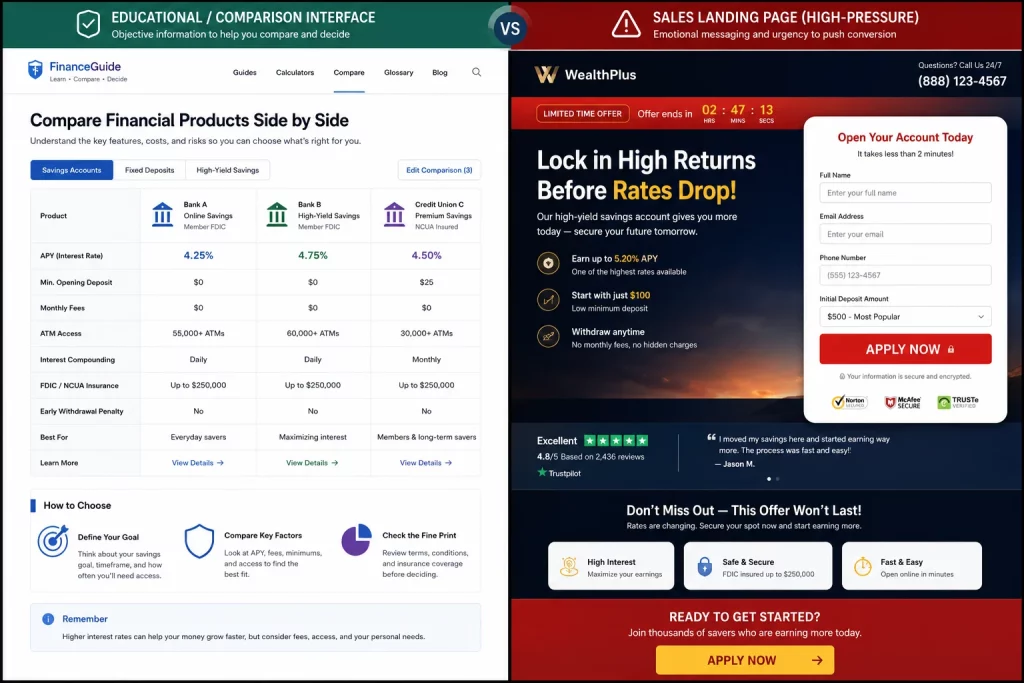
[IMAGE PLACEHOLDER | Search Keywords: financial website user interface cta comparison analytics dashboard | AI Brief: A dual UI screenshot mockup comparing an educational financial comparison chart interface against a high-pressure financial product sales landing page with prominent “Apply Now” forms. | Alt Text: Comparing user interfaces between an independent financial information website and a direct financial product sales website.]
3. Objectivity and Depth of Content
The quality and depth of analytical content reflect the publisher’s underlying motivation:
- Multi-dimensional Analysis: A high-quality information article allocates equal attention to analyzing both benefits and risks. The piece clearly answers: “Under what circumstances should you NOT use this product?” or details cancellation penalties and interest rate fluctuations.
- Promotional Content: Sales websites focus solely on short-term perks, employing urgent phrasing (“Limited Time Offer,” “Instant Approval Today”) while burying disadvantageous terms in fine print at the bottom of the page.
4. Timing of Personal Data Collection
The timing of data requests serves as a key safety indicator:
- Educational financial websites only collect emails if users proactively subscribe to a newsletter or download resources. They never require personal financial information just to let users read an article.
- Lead-generation platforms often block content behind mandatory forms requiring income, phone numbers, or ID credentials before displaying comparison results. This indicates that your personal data is the product being commercialized.
A 3-Step Process to Quickly Assess a Financial Platform
To ensure safety before relying on information or conducting a transaction, apply this 3-step verification process.
Step 1: Check the Footer and Operating License
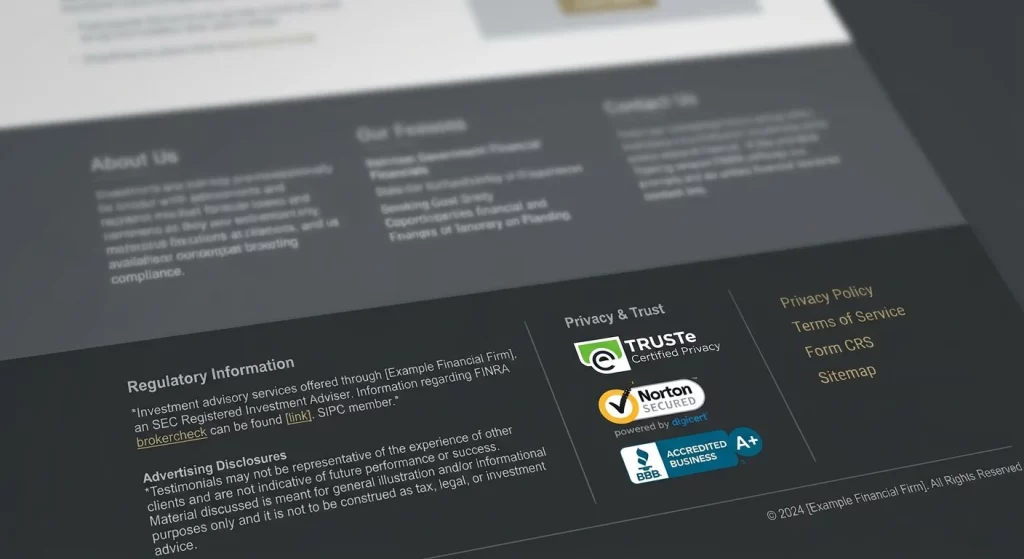
Scroll down to the bottom of the webpage and check the footer. A legitimate financial institution or publisher must provide: official company name, headquarters address, business registration number, and operating license numbers issued by regulatory authorities (such as the Central Bank or Securities Commission).
Step 2: Uncover the Revenue Model (“How We Make Money”)
Look for links titled “Advertising Disclosure,” “Affiliate Disclosure,” or “Editorial Policy.” Read these carefully to determine whether product rankings on comparison tables are influenced by compensation paid by partner banks or institutions.
Step 3: Cross-Reference Risk Warnings With Independent Sources
When finding a suitable financial product on a comparison site, do not sign up immediately on that platform. Access the official website of the issuer directly (bank, insurance company, brokerage) or consult independent forums to cross-reference fee structures and legal terms.
Frequently Asked Questions (FAQ)
Are financial comparison websites (like NerdWallet or Bankrate) information sites or sales sites?
These platforms operate under a “commercially affiliated financial comparison” model. They provide high-quality educational content but generate revenue through affiliate marketing. They display transparent advertising disclosures; however, product placement and ranking order can still be influenced by commercial agreements with partners.
Why do financial product sales websites rarely publish detailed risk analyses?
The goal of a sales website is to maximize conversion rates. Detailing risks, hidden fees, or unfavorable terms creates friction and lowers conversion rates, leading publishers to minimize or omit this information.
How can I verify if financial content complies with legal regulations?
Standard-compliant content includes author/expert credentials, last-updated dates, direct links to regulatory legal documents, or official statistics from government financial authorities.
Should I enter personal information on loan or interest rate comparison websites?
Only input non-identifying estimates (such as desired loan amount or term) for calculation testing. Never submit sensitive personal identifiers (national ID, bank account numbers, passwords) on intermediary sites whose financial brokerage licenses cannot be independently verified.